
History 1: The book
The Monuments of Westminster Abbey: Power and Memory in Early Modern Britain

Today was the day - and what an appropriate day too! I got home from day 1 of the biennial ANZAMEMS conference at the University of Melbourne to find my book had finally arrived, released as a paperback. A frantic 10 second check that the last proof changes had actually gone through, a flick through the 28 illustrations to confirm they were of reasonable quality, and it was time to breathe in deeply and feel greatly satisfied. 18 years after I first conceived the idea, the magnum opus was finally a reality.
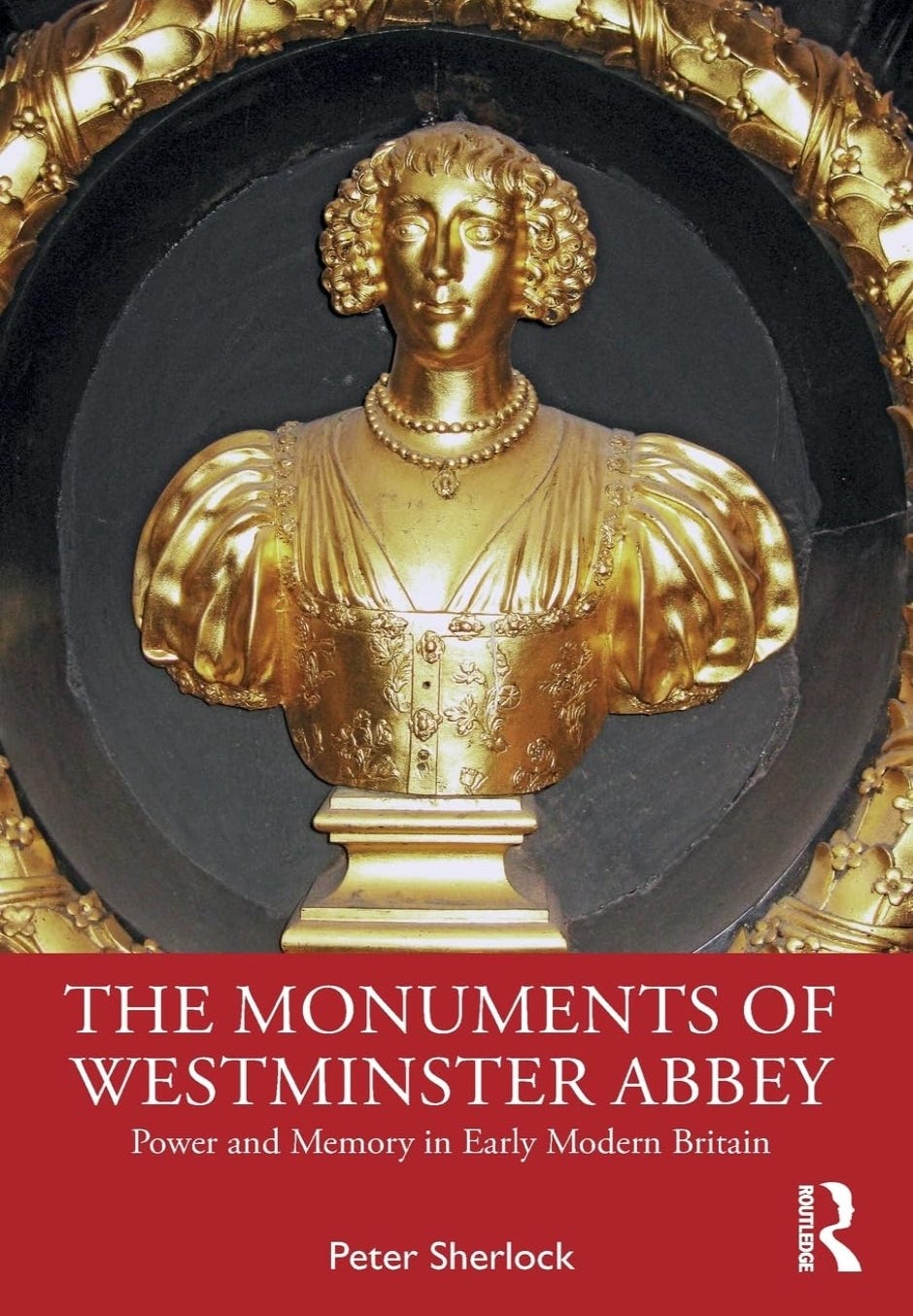
So why did I write a book about the sixteenth- and seventeenth-century monuments of Westminster Abbey?
This is a world heritage site, packed with over 600 monuments ranging across 1,000 years of history. There are many other books about it - but surprisingly there is no critical account of the monuments.
Originally I hoped to do the lot. Then I realised there was no critical account for one very good reason: it’s just too big a project. Previous attempts have ended up being catalogues, without an overarching narrative that explains the how and why of Westminster’s famous tombs.
In the end I chose the period I know best, from the reign of Henry VII to the restoration of the monarch. I wanted to understand how the Abbey was successfully (and to some extent, accidentally) converted from a royal monastery seeking to draw pilgrims into a tourist destination visited by thousands and now millions each year. The turning points proved to be quite precise (1556 and 1656) … but you’ll have to read the book to find out why.
I write history because I believe that, in searching out the evidence, piecing together what actually happened, questioning assumption and ruminating on what it all means, there is always a surprise that speaks to our present and future. In this project I found three surprises that delight and perplex me.
First, who knew that many of the Westminster Abbey tour guides in the seventeenth century were also singing men in the choir? It was like finding my own signature in a 350-year old account book.
Second, people don’t just visit monuments to meditate on grand or grave themes (excuse the pun). They do it because it’s fun. Early modern tourists were not that different from those of today, spending a penny to poke fun at the tour guides, marvel at a sparkling gold statue or a richly-dressed wax effigy, and maybe learn a thing or two about the body politic on the way.
Third, I discovered that dead bodies matter. I didn’t just finish the book at the end of the 1600s because I ran out of puff. I finished there because I lost interest in the material. From 1660 onwards, monumental commemoration in Westminster Abbey became increasingly separated from the mortal remains of those memorialised. And without this vital, intimate connection between life, death and memory, I couldn’t see the point of a monument in the Abbey.
It’s rare I’m as satisfied with work as with this book, and I hope it stimulates conversation, debate, and maybe even a change in how we remember the dead in our own time and place.
Stay tuned for book launch details - and in the meantime, you can of course buy the book online.