

Back in the 1960s one of my favourite English spiritual writers, Monica Furlong, brought all her talent as a journalist to bear on one of the key moral questions of the day: should homosexual activity between consenting adults be decriminalised? A unique aspect to Furlong’s advocacy was her theological argument that the Church of England should be in the vanguard of the campaign. This was an unusual but not altogether radical point of view at the time. In my hometown of Melbourne, for example, the Anglican Synod voted as early as 1971 to support the decriminalisation of same-sex activity, some ten years before the Victorian Parliament took this step.
Fast forward 60 years and Anglicans around the world are fighting more than they ever have about sexuality. At stake in many parts of the globe is still the criminalisation and corporal punishment of people who identify as gay or lesbian or who engage in sexual activities with a person of the same sex. For the last few years in Europe, North America and Australia (while some may still wish to lock us up or burn us) the core issues have been whether or not Anglicans may marry their same-sex partners and whether or not those relationships may be blessed by the church.
Thus for most of the last decade the Church of England has been engaged in a protracted process known as “Living in Faith and Love”. The idea was to engage English Anglicans in theological reflection and dialogue to discern the Holy Spirit’s guidance, in the hope of resolving decades of fractious divisions. Yet division seems as strong as ever. On the one side are those who believe clergy should no longer be barred from marrying their partners and those who believe same-sex intercourse is intrinsically sinful. Both sides produce arguments from scripture, and both lay claim to discerning the Spirit’s call.
Here in Australia, the conversation has stalled entirely. The lack of encouragement let alone compassion or even basic understanding for those of us at the centre of the debate is beyond disheartening. Friends often ask why I stick around so stubbornly. Well, the Church is still the Body of Christ and as the hymn puts it, “Christ doth call one and all, ye who follow shall not fall”.
So is there any way forward from the present impasse beyond making martyrs of each other?
Recently I re-read the 39 Articles of Religion, about the closest thing Anglicans have to a confessional statement. Written by the bishops and clergy in 1562, drawing on older statements, they were finally approved by Elizabeth I in 1571. They still have a critical place in Anglican life. The Constitution of the Anglican Church of Australia declares the “Book of Common Prayer, together with the Thirty-nine Articles, [are to] be regarded as the authorised standard of worship and doctrine in this Church” (section 4). Whether in church services or in church law, Australian Anglicans are obliged to eschew practices that contravene this authorised standard.
Not a lot of people read the 39 Articles these days. More’s the pity for they are a hidden treasury of Anglican wisdom offering some much-needed theological gems. Want to understand how predestination works? Read Article 17 (yes there is predestination, no we can’t predict God’s mind so worrying about it is pointless). Concerned that your church is straying from Jesus’ teaching? Examine Articles 20 and 21 (church councils can get it wrong). That’s not to say I could sign up to the plain and literal meaning of all the Articles, especially Article 37 (I cannot support the death penalty).
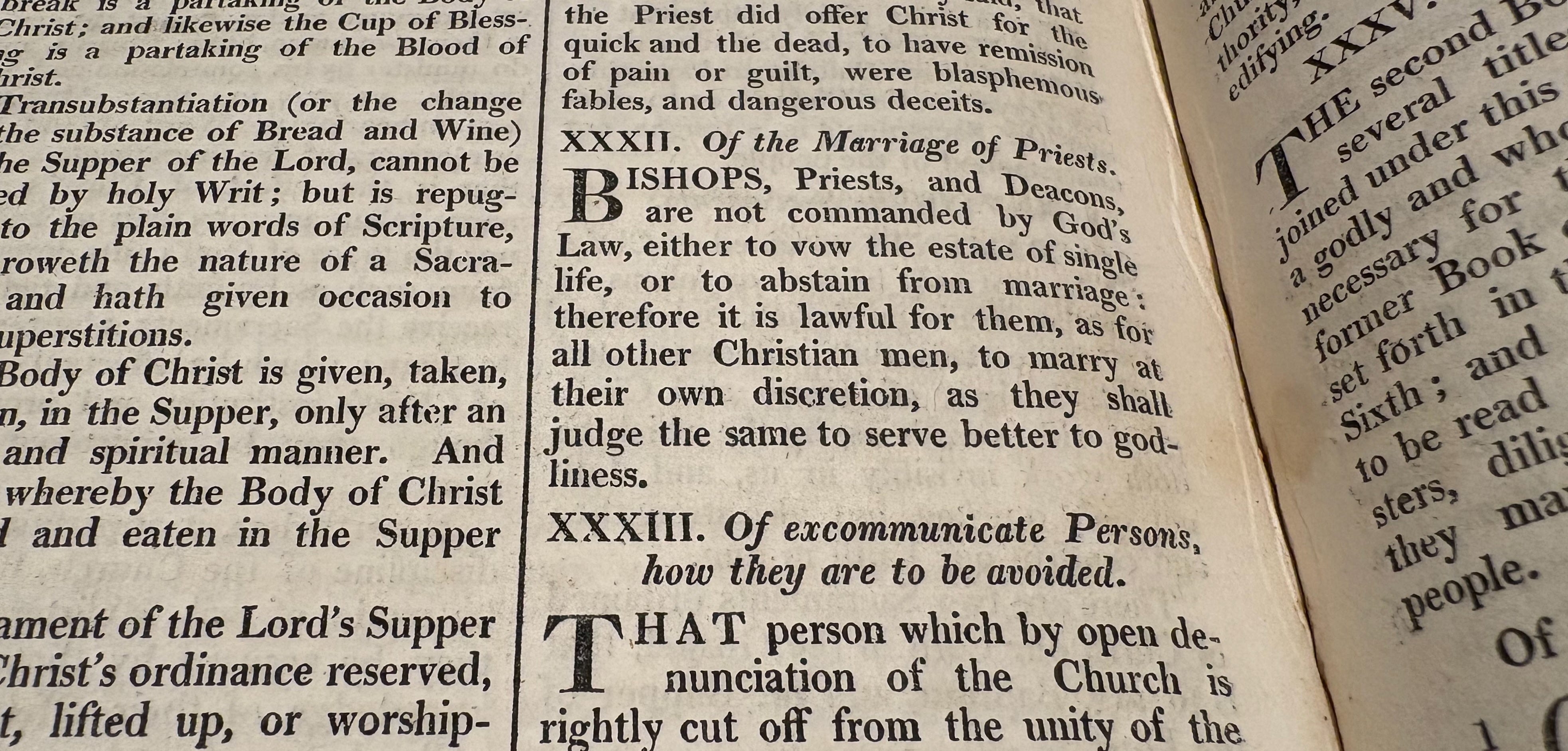
I was surprised anew by the language of Article 32. The 1571 text states plainly that:
Bishops, Priests, and Deacons are not commanded by God’s laws either to vow the estate of single life or to abstain from marriage. Therefore it is lawful also for them, as for all other Christian men, to marry at their own discretion, as they shall judge the same to serve better to godliness.
The marriage of the clergy was a protracted and bitter controversy for at least three decades during the sixteenth-century Reformations as English reformers found no basis in scripture for the Roman tradition of clerical celibacy. Clerical marriage was debated viciously, full of swearing, name-calling, and demonisation of one’s opponents, with little thought for the people most affected - the wives of the clergy.
Evangelicals began to marry secretly from the earliest days of the Reformation and from 1547 many bishops and clergy came out as married. When Mary came to power in 1553 they were swiftly punished - forced to renounce their wives, flee to Europe, or in some cases face execution for heresy. Under Elizabeth I clergy could once again marry, but there was no explicit legal provision for these marriages until the seventeenth century. Even the Archbishop of Canterbury, Matthew Parker, had to take extreme steps to ensure that his wife Margaret was provided for after his death.
In this context, Article 32 was not a trite statement. It ruled out compulsory celibacy then gave clergy freedom to determine whether or not marriage was right for them. Bishops, priests, and deacons were expected to exercise their conscience “as they shall judge the same to serve better to godliness”. They were not required to sign up to a synod-approved code of conduct or to lie about their relationships, and no-one was forced to marry.
Could it be that Article 32 offers a way out of the current impasse? What if Anglicans took a more gracious path, seeking out in each other signs of the exercise of good conscience “to serve better to godliness”? To continue to police each other’s discernment is a recipe for division and death. All we need is to trust that our brothers and sisters have read the scriptures, prayed for the Holy Spirit, and acted on their conscience. What could be more reformed than this?
With respect Peter, I don't think you are doing justice to Article 32 when read in context.
The Articles start under the statement "Articles of Religion: Agreed upon by the Archbishops, Bishops, and the whole clergy of the Provinces of Canterbury and York, London, 1562". Article 6 confirms the supremacy of Scripture as containing all things necessary to salvation 'so that whatsoever is not read therein, nor may be proved thereby, is not to be required of any man, that it should be believed as an article of the Faith, or be thought requisite or necessary to salvation' and Article 20 grants the Church authority 'to decree Rites or Ceremonies, and authority in Controversies of Faith' but subject to Scripture.
In this context, Article 32 is just affirming that Scripture doesn't require clergy to be married or remain unmarried. Article 34 follows a similar pattern and yet can affirm that '[w]hosoever through his private judgement, willingly and purposely, doth openly break the traditions and ceremonies of the Church, which be not repugnant to the Word of God, and be ordained and approved by common authority, ought to be rebuked openly, (that others may fear to do the like,) as he that offendeth against the common order of the Church, and hurteth the authority of the Magistrate, and woundeth the consciences of the weak brethren.'
I am not advocating slavish conformity to the Articles - my point is that the Articles do not support your argument.
Wise, measured, and deeply Anglican. You remind us Peter that Article 32 was never a bureaucratic footnote but a profoundly pastoral gift: freedom of conscience exercised to serve better to godliness.
Perhaps the tragedy of our current stalemate is not disagreement, but mistrust — the urge to police rather than to discern. Your call to recover a Reformed confidence in scripture, prayer, and conscience feels not radical, but refreshingly orthodox. If we cannot trust one another to act faithfully before God, we have already surrendered the heart of our tradition.
Thank you for naming a more gracious, and frankly more hopeful, way forward.
Kevin.