

It’s hard to do the write up tonight: a long day of both intense concentration and heart-work. I’m shattered. Three people kindly checked I was okay at the end of the day and I said I’m not crying, I’m just dehydrated and exhausted and that’s why I need a hanky. So please excuse any errors, typos, or omissions.
Yes there was much praying. We did actually sing, just once, today: three “alleluias” as the gospel was introduced at the 7am eucharist. It was so hard to say the Te Deum at morning prayer and the Magnificat at evening prayer. Maybe I am just a nerd about this?
Bishop Mark’s Presidential Address is now available on the General Synod website and I urge you to read it.
Questions
We heard answers to questions asked over the last couple of days:
the total cost of the Episcopal Standards Commission in 2024, 2025 and 2026 (to date) is $983,823
revisions to Faithfulness in Service taking into account feedback from consultation will come to Standing Committee in November
Doctrine Commission reports from the last 4 sessions of General Synod are available on the General Synod website on the Doctrine Commission page
We had one new question from the father of the house, Robert Tong (Sydney) asking about protocols agreed by the House of Bishops.
Motions
There were quite a few notices of motion:
Motion of thanks to Dr Ian Gibson for his service as Chair of Committees and Chair of the Church Law Commission
Asking Standing Committee to use average weekly earnings instead of CPI for expenditure growth, and asking dioceses to make a further contribution to assessment
Urging dioceses to adopt the Canon on the protection of the environment and to meet its reporting requirements
Celebrating inclusion of neurodiverse people
Requesting presentations on General Synod’s finances to occur on day 1 of future meetings
In the callover of motions, two were formally approved:
24.7 proactive approach to youth and children’s ministry
24.8 thanks to three retiring members of the Appellate Tribunal
Decisions made
It was another big and complex day for decision-making:
Motion 16.15 seeking $5,000 (not a typo) to fund a face to face meeting of the Safe Ministry Commission was recommitted owing to technical issues with the electronic voting, and was lost 126:105 votes
Bill 8, a constitutional amendment to clarify that a bishop can be bishop of multiple dioceses, was introduced in an amended form and after a long debate was withdrawn in favour of an amendment to motion 16.4, recognising while there was majority support in the Synod for the bill, it looked certain that it would not gain sufficient support across the dioceses (also see John Sandeman’s write-up)
Bill 16 and 17 passed, providing for the Defence Force Bishop and chaplains to be represented in General Synod
Bills 14, 15, 18, 19 all passed and were concerned with largely technical updates (General Synod staff cannot be members of taskforces or commissions, repeal the Australian College of Theology Canon as it is now independent of General Synod and has achieved university status, updates to long service leave arrangements and to the General Synod Trust Corporation)
I finally got involved in General Synod processes after making a grandstanding speech opposing Bill 8 on the grounds that a fundamental principle of the English Reformation was “one bishop, one diocese” as the reformers sought to outlaw plurality of sees and to require bishops to be resident in their dioceses. My sense was that a majority in the room supported permitting one bishop, multiple dioceses, but what was really wanted were strong temporary measures that made it possible for one diocese’s need to be met by another. So I sent a revised draft of the bill framed around the idea of a “provisional diocesan bishop” to the mover, and found myself in lunchtime and afternoon tea meetings (General Synod terminology is “huddle” but I do value my personal space) that converted the bill to a motion. It felt like I should have been having these conversations two or three years ago; mea culpa. It also often felt like I was part of the “metropolitical clique” solving problems for rural and regional dioceses I do not comprehend.
Upside 1: could Ellyard Sherlock Gibson be a thing?
Upside 2: could I work with Bishop Michael Stead more often?
Most interesting encounter
Two lay members of the Synod from different dioceses came up and introduced themselves, and invited me to their place, speaking to me of open table and hospitality across difference. These were both very generous responses to my intervention at the 2022 Synod and I am profoundly grateful for this expression of Christian fellowship.
Best speech of the day
This is a tricky one, a few contenders and no complete stand out. I’m awarding this one to our guest, the wonderful Dr Robin Ray who spoke on the 150th anniversary of the Mother’s Union and challenged a lot of our assumptions. Did you know that Anglican Mothers Union Australia has a strategic plan? They have five objectives that are worth reading. They want to be aligned with the work of the national church and its parishes, asking “how we can build up the church by encouraging families through faith with action”.
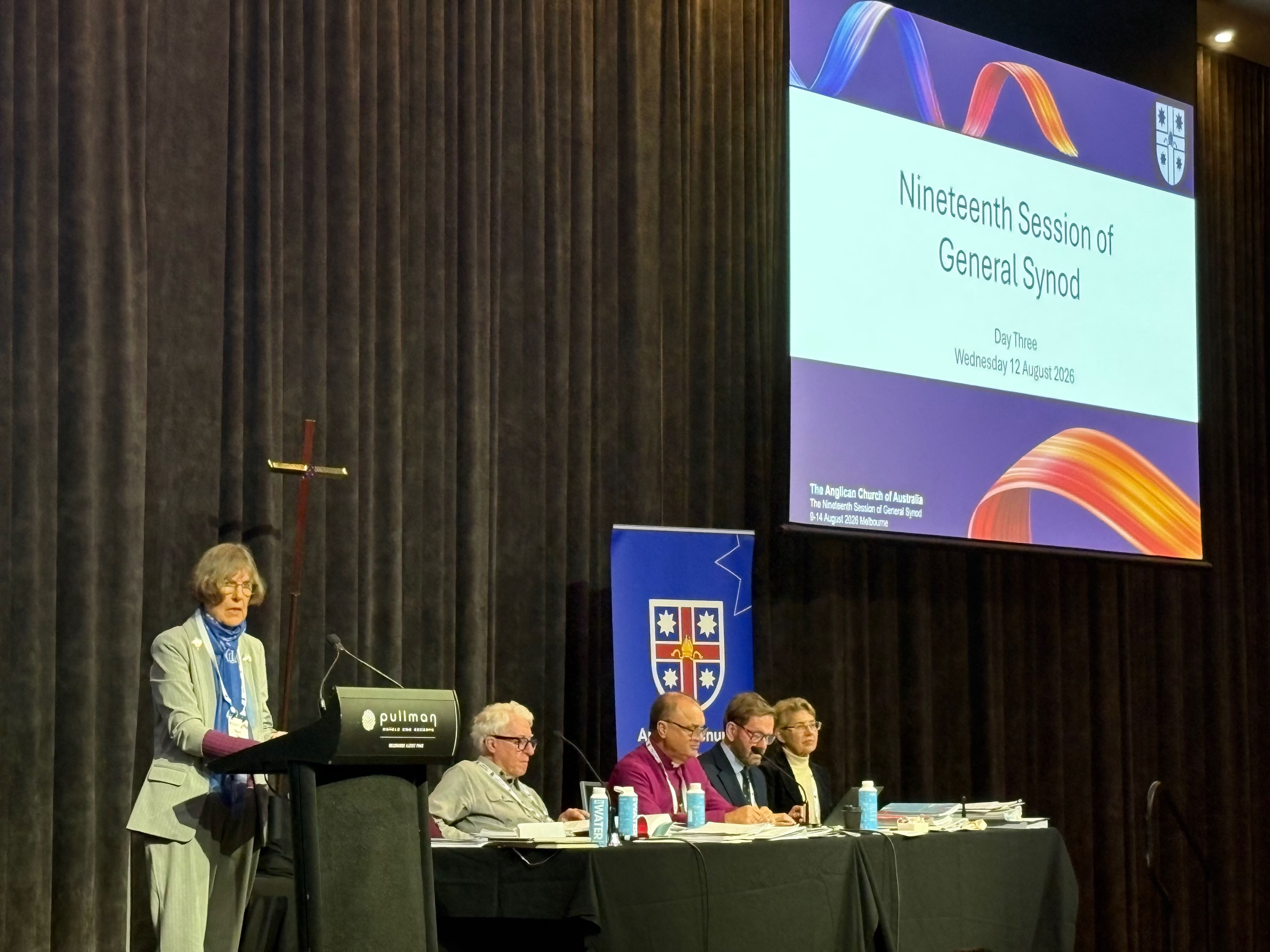
Quote of the day
Halfway through the afternoon the Primate’s chair collapsed, causing the Primate to quip “I’m fine it’s just my seat has collapsed. My seat not my See.” (Bishop Mark, we all hope you really are ok!)
The big picture
So the Mother’s Union has a strategic plan. Does the national church? No.
But we do have strategic priorities, and these may be found in the Standing Committee’s report (Book 2 of the General Synod papers) at page 42:
At its November 2022 meeting the Standing Committee reviewed the GS18 resolutions and resolved to confirm the following five strategic priorities:
The work of evangelism in the National Church
Diocesan co-operation and working together more effectively, including a sharing of resources to ensure ongoing viability and reduction of duplication
A ministry of national reconciliation
Resourcing the National Aboriginal Bishop and future resourcing of a National Torres Strait Islander Bishop
Climate change, including Aboriginal, Torres Strait Islander and Blue Pacific engagement, and support for local churches in crisis.
It’s a pretty comprehensive list, and it is reflected in motions and bills Standing Committee placed before the Synod, though there’s rather less about climate change than the other topics.
But why isn’t the General Synod having this conversation - whether in plenary session or in small groups, as we did in 2014 for the Viability and Structures project? Shouldn’t the General Synod be endorsing, refining, proposing these strategic priorities?
Standing Committee’s list does not include prevention of gender-based violence, although this was an area that the last General Synod agreed should be funded for three years. So it should come as no surprise that the Synod rejected the last motion of the day, brought by the Families and Violence Commission seeking continuation of funding. Several speakers highlighted that this was in fact profoundly missional, evangelistic work. It was just about the hardest way we could have ended the day, with most speakers agreed on the critical need to support specific Anglican ways of preventing and responding to family violence but divided on whether we could in fact afford this. I sided with the majority in agreeing we just do not have the financial resources, while praying that one of our larger dioceses might step up to fill the void.
As I got more involved in Synod business during the day, I discerned there is something seriously dysfunctional in the culture of our national church that I intuit has built up over decades if not a century. We seem unable to go through a straightforward process of naming a problem, then crafting what a couple of speakers called a “playbook” of responses and, where necessary, designing legislative responses for Synod to consider.
Two holes seemed present. First, solutions did not seem to map on to the problem. So in Bill 8 the problem we were trying to solve was, some dioceses in existential crisis can’t solve their needs because they end up without a bishop and without funds to pay one. The solution we got to - invite dioceses to manage risk by providing for non-episcopal administrators to do as much as possible, and invite other dioceses to provide episcopal ministry whether by temporarily seconding an assistant bishop, a retired bishop, or, yes, installing a diocesan bishop as a provisional diocesan bishop - actually addresses the issue.
Second, we seem to regard problem solving as, well, someone else’s problem. It’s negatively framed: a black and white question of “how do we solve this problem”, not a colourful, kaleidoscopic view of “how do we create opportunity”.
My suspicion is that Standing Committee - where our national church necessarily takes shape in between General Synod meetings - is hampered by what I will call barrier thinking. We try to identify the barriers preventing flourishing and growth, and then seek ways to destroy them, or to tunnel under them. I think this was an issue in the “bishop of multiple dioceses” approach. No one really thought this was a good idea, but it looked like a workaround solution to the problem of “some dioceses can’t afford / can’t find a bishop”.
We need instead to start from boundaries not barriers: boundaries as a place to negotiate, boundaries that are transparent, boundaries that invite possibility where outsiders are welcomed in, and insiders travel abroad.
Over afternoon tea (minus the tea) I found myself in a fascinating conversation with Bishop Matt Brain (Bendigo) and Renae Barker (Bunbury). I asked them if they thought lack of trust was the main problem in the national church, something I’ve written about in previous days. Bishop Matt suggested the problem was actually vested interest: it’s not so much that we mistrust our brothers and sisters, it’s that we act to protect our own interest, power, privilege, custom, habit. I think he is absolutely right and I have much more reflection to do on this.
Both Renae and Bishop Matt then pointed to a range of initiatives they were leading in their dioceses to promote sustainability and manage risk, not just for themselves but for other dioceses. It seemed to me we lacked a culture in which we naturally share those ideas, encouraging creativity and shared problem solving, making something bigger than the sum of its parts. A short conversation suggested to me there is a lot more talent in our national church than we are using. Why?
Theological reflection
I have no energy left for this one tonight. Loving our neighbours in the church, and expressing this love by listening to each other’s stories and through sharing our imaginations, are critical to our integrity in Christ and to our future.
What’s next
We will now spend the remaining day and a half working through the remaining motions, completing the elections, and finalising the budget.
Please say a prayer first and foremost for the General Synod staff, the Primate, the Standing Committee members, and the legal officers, as well as for the members, so we can acquit our responsibilities well with enough energy and good heart as we head towards the finish line.
I'm questioning my sanity reading your posts. They are excellent posts, but hanging as I do in the UC and local government, say no more. Lord bless you and our Anglican sisters and brothers in Christ.
Thank you Peter.
Did the motion on neurodivergent inclusion pass?