
Discerning and Disclosing Wisdom
Homily 4 - A Vision for the Australian Centre for Christianity and Culture

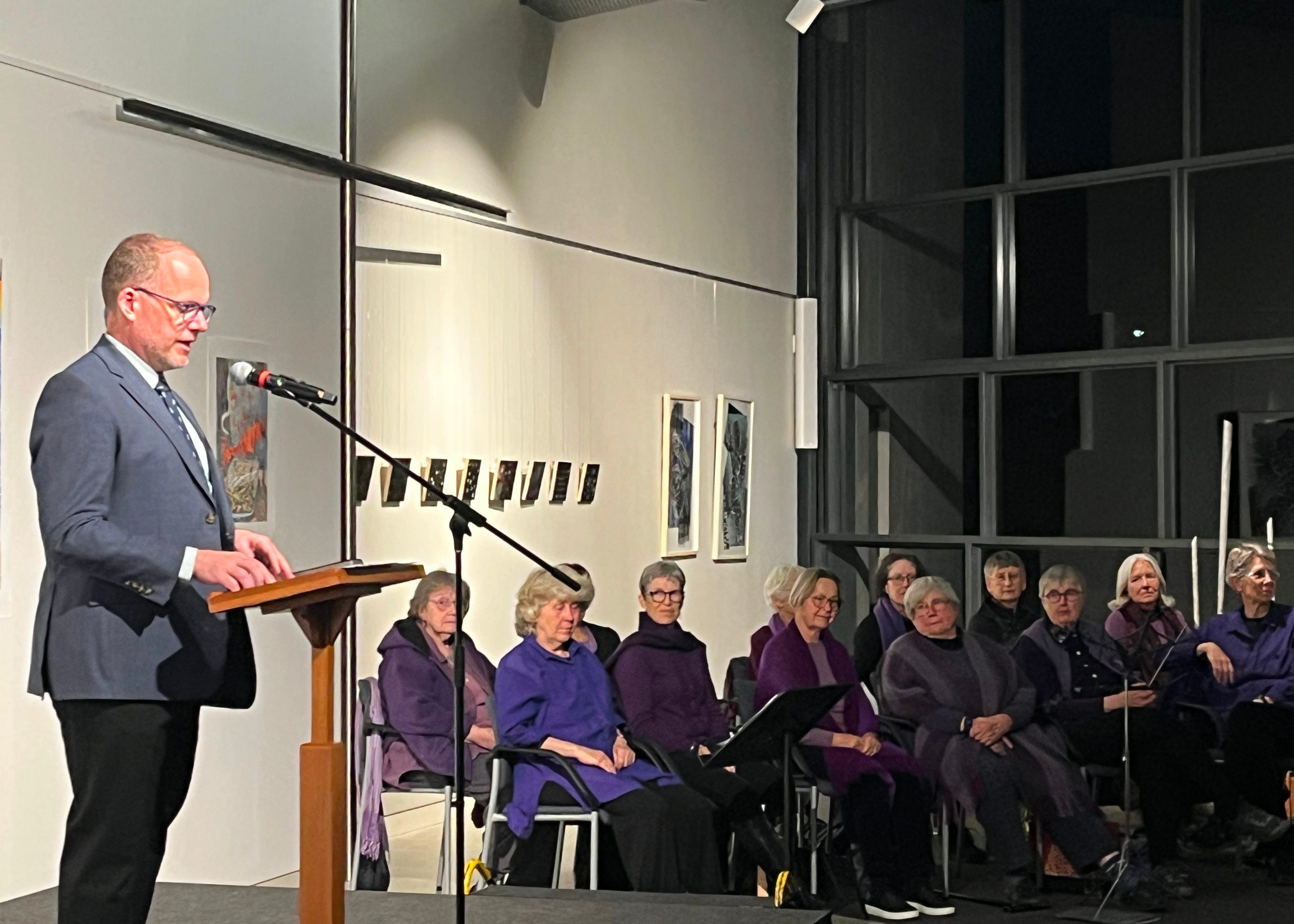
I gave this speech at my commissioning in Canberra on 8 May 2026 by Bishop Mark Short to serve as the Executive Director of the Australian Centre for Christianity and Culture with Yindyamarra Nguluway, Charles Sturt University. The reading was Proverbs 8: 1-12.
I begin as I mean to go on with a spirit of thankgsiving.
I give thanks for God’s grace in bringing me to this place at this moment, and for the Spirit’s gift of discernment.
Thank you Stan Grant for your trust in taking me on at Yindyamarra last year.
Thank you Lin Hatfield Dodds, Bishop Mark Short, the Centre’s Board and Charles Sturt University for your confidence in appointing me to this role.
I thank my partner Craig D’Alton, who could not be here this evening, for giving me the freedom and support to take up a role in Canberra.
Thanks to all of you for your many gestures of welcome over the past few months. One of the advantages of coming into this role after a period as your acting Executive Director is that I have had the opportunity to get to know many of you, your stories, and your hopes and dreams.
Thank you to A Chorus of Women for your music and to Toni Hassan and her colleagues for the creativity of this Beyond exhibition.
And finally, thank you to Jonathan Cole and Sarah Stitt for your extraordinary dedication over the last few years in keeping the Centre afloat and preparing us for the next stage of the voyage. The Centre owes you a great debt.
My primary academic training is in history, so it is incumbent upon me to remind you that 8 May 2026 is a significant date.
On this day Anglicans commemorate Julian of Norwich, a fourteenth-century mystic from the other side of the globe. All shall be well, and all manner of things shall be well – potent words for this turbulent global moment.
On this day my mother commemorates the fortieth anniversary of her ordination to the diaconate in Melbourne. This development continues to be an extraordinary example of how theological imagination can literally change the church and the world. For with God, nothing is impossible.
On this evening the family, friends and colleagues of Jione Havea are gathering in Sydney for a wake, commemorating the untimely death of a Pasifika biblical scholar whose prophetic voice called us to attend to the radical possibilities of God’s vision for both church and world.
And on this day exactly ninety-nine years ago a group of Anglican bishops came to this place to dedicate it as the site of a national Anglican cathedral, Australia’s Westminster Abbey. Yes, there is a reason my book on Westminster Abbey is being launched here tonight!
All of these commemorations call us to consider wisdom. The Book of Proverbs tells us of wisdom’s call:
To you, O people, I call, and my cry is to all who live.
O simple ones, learn prudence; acquire intelligence, you who lack it.
The Centre’s motto is wisdom for the common good. This is undoubtedly what we need at a time like this. But wisdom does not drop miraculously from above. Moreover, finding wisdom is insufficient.
Wisdom must be both discerned and disclosed.
Before we embark on renewal of the Centre’s research and public engagement, on renewal of this precious place, we must first ask how we go about the getting of wisdom. I suggest three answers for you tonight.
From Christianity come the two great commandments of the scriptures: love God and love neighbour. They must guide all that we do.
From our location in Canberra, the nation’s meeting place, comes the imperative for gathering, for dialogue, for prophetic witness. This is the great opportunity we have been given.
From the Wiradjuri people comes yindyamarra – respect, paying attention, going slowly, being willing to listen. This is how we should conduct our work.
Drawing these three possibilities together indicates the unique role of the Australian Centre for Christianity and Culture at this time, here in Canberra and across this land.
The Centre begins with theology. What is theology? It is the search for knowledge of God, it demands that we read the signs of the times and the shape of things to come. Unlike most theological colleges and universities that rightly focus on the formation of people for Christian ministry or the intellectual development of theological disciplines, the Centre is called to do something different. This is what my colleague Jonathan Cole has termed “theology plus”. We draw theologians into dialogue with experts from other disciplines: economics, the performing arts, politics, education – the possibilities are endless. As I argue in my book Theology Matters this engagement results in surprising new possibilities, out of the box solutions. In attending to the transcendent aspects of existence we can glimpse what lies over the horizon. Theology requires us to confront the reality of death and, in remembering to die, to discover how we might truly live.
Second, of necessity the Centre works through partnerships, not just because our resources are small, but because partnership is fundamental to how we discern and disclose wisdom. This is why we continue to work ecumenically, with people of other faiths, with people of no religious belief. In a time of social division and challenge to the foundations of democracy, our vocation is to host the challenging conversations that others cannot have or are unwilling to have. This means being willing to address conflicts, but it also means having the courage and capacity to imagine, to dream.
Third, the Centre draws on yindyamarra as its ethos, its discipline. The way we host conversations, undertake research, engage with others, is to be characterised by respect. Participation in our activities implies a willingness to listen, to admit I – you – do not have all the answers. Through yindyamarra there is an opportunity, one by one, community by community, to spread light in the darkness and to offer a more gracious way of belonging in this land.
So our unique task at the Centre is to host the conversations that matter, that inspire, that help shape a world worth living in. In partnership with NCLS Research and with Yindyamarra Nguluway, several strands of activity are emerging:
Economics and theology, where we engage critically with what for the past half century has been the master discipline of our age.
The future shape of Christianity, where we describe, analyse, and imagine the signs of the times that God is placing before the church, drawing on robust evidence of the kind gathered by the National Church Life Survey.
Education and theology, where we seek to grow the spiritual capacity and wellbeing of children and young people and to improve religious literacy, something Australia desperately needs.
First Nations theology and spirituality, where First Peoples and later arrivals together might nurture truly Australian forms of Christianity grounded in these lands and cultures. What could an Australian Bible Commentary look like, developed as a partnership between Australia’s many exceptional biblical scholars and Aboriginal and Torres Strait Islander communities, that in time informed every sermon preached across this vast land?
Reimagining this site and how it might be a light on the hill, a place for local community and for shaping our national story. There have been many such visions in the past, from Australia’s Westminster Abbey to Bishop Burgmann’s hope for a genuinely Australian theology to St Mark’s and the Centre as we find them today. Here we will need to tread gently, humbly, and slowly as we discern this site’s future purpose.
Finally, as I step into this role as Executive Director, I ask for your support for me and my colleagues – Stan Grant, Dominic O’Sullivan, Liz Laidlaw, Ruth Powell, Jonathan Cole and Sarah Stitt – especially through your prayers, your imagination, and your encouragement.
Thanks for the share, interesting to read of the centre's vision. Theology and economics looks intriguing, and in an Australia where economic benefits for the population are probably less equal than aspired to in founding, where power and so on is very much centred on, it's definitely a good topic. I work in urban planning which plays a role economically, and is very much influenced by the economy, and what I call 'land economics'. Happy to chat off-line if of interest!
Dear Peter, it is good to receive your outline for your commissioning talk.
The motto says it all: "wisdom for the common good."
I have also found that maybe I am receiving a "good message " when emails come into my presence just as I am embarking on searching out the "next step" in my ministry career - so thank you for the "click."
I am a recently retired Anglican Chaplain and Anglican Deacon, and I have a reputation for speaking out on social justice matters and for crossing awkward boundaries!! :)
The journey took me from the Diocese of Melbourne to Newcastle, to Bendigo and then Melbourne again.
My news is that I have been accepted to write a book for publication with Cambridge Scholars entitled "The Spirituality of the Anglican Deacon - An ethnographic record -the work of Australian Anglican Deacons." I say this in the full knowledge that you have a thesis in this area, time past.
I think connections through the University library access, for example, might assist me in this endeavour. Are you able to assist me?
josephine 56@icloud.com
Blessings and peace,
Reverend Josephine