
Australia's Anglican General Synod meets next week. So what?
Heresy 5

On Sunday 9 August 2026 the General Synod of the Anglican Church of Australia will assemble in Melbourne. I will be at the opening service in the dual guise of second bass (cantoris, please) and lay member representing the Anglican Diocese of Melbourne. This will be my third General Synod; I previously attended sessions in 2014 (Adelaide) and 2022 (Gold Coast).
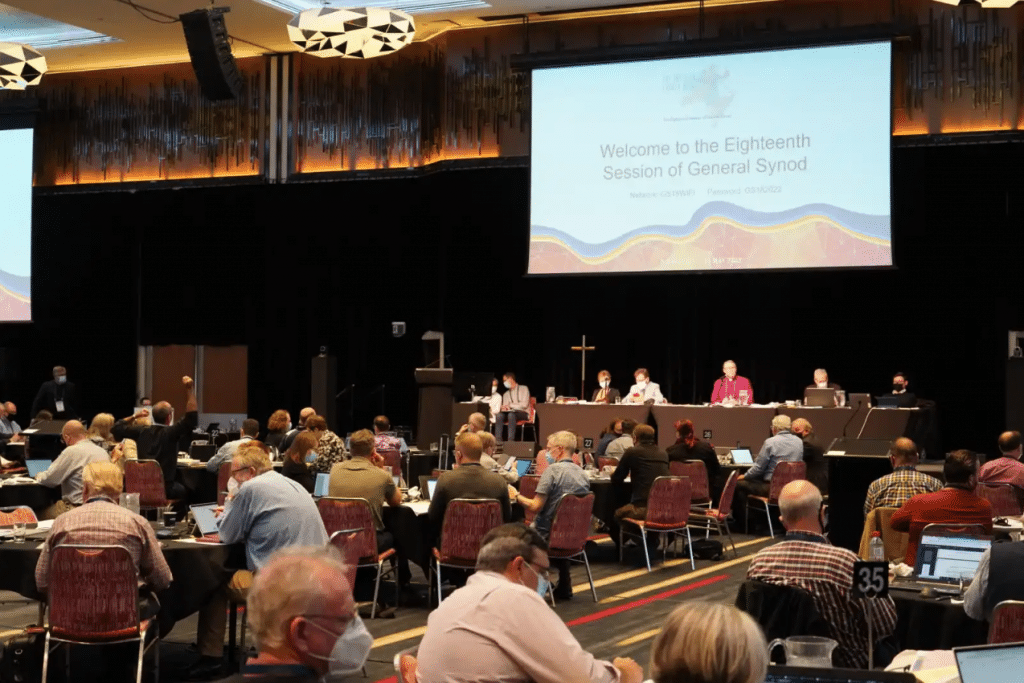
I have to admit that the General Synod doesn’t have a great track record in spreading the good news of Jesus. But in fairness, it was never designed to be a means of propagating the Christian faith. Instead it was intended, in the kind of establishment imagination only Anglicans can produce, to be a national Anglican Parliament. Under our national church Constitution, the General Synod has the power to:
Make canons, rules and resolutions relating to the order and good government of our Church, including canons in respect of ritual, ceremonial and discipline;
Make statements as to the faith of our Church;
Declare its view on any matter affecting the Church;
Declare its view on any matter affecting spiritual, moral or social welfare; and
Take such steps as may be necessary or expedient in furtherance of union with other Christian communities.
The first General Synod met in 1872, though it was an unincorporated body made of voluntary participants from around what were then the Australian colonies. At that first meeting it focussed on creating local mechanisms for appealing the decisions of a colonial bishop or diocese without having to post the appeal to the Privy Council in England. Those mechanisms were soon put to the test by the infamous case of a bigamous priest in Adelaide … but that’s another story.
Attempts to create a body with statutory authority to shape a truly Australian Anglican church - one that might, for example, authorise its own liturgical texts - almost succeeded in the 1920s but failed under the weight of Australia’s rampant diocesan independence. It was not until 1961 that the constitution of the Church of England in Australia and Tasmania (don’t ask) was finally adopted after a tortuous process involving 25 diocesan synods and several secular parliaments. And it was only in 1981 we got our name changed to the slightly less colonial Anglican Church of Australia (but the 2026 Census still only allows us to identify as “Anglican (Church of England)”). The 1961 constitution is deliberately weak: nothing the General Synod decides has any effect unless a local diocese adopts it. This isn’t the Church of England.
Notwithstanding its weakness, the General Synod made significant progress over its first thirty years. Notable achievements include An Australian Prayer Book (1978) and its successor A Prayer Book for Australia (1995), establishing locally authorised Anglican liturgies that (finally) provided an alternative to the Book of Common Prayer (1662). Tellingly it was the General Synod that ultimately opened the way for the ordination of women as deacons (1985) and priests (1992), though the consecration of women as bishops was achieved by reference to the Appellate Tribunal, not a canon of General Synod. I’m proud to say my father was a member of that 1992 General Synod that voted to allow my mother’s priestly vocation to be recognised - and ashamed to say diocesan politics meant he was not elected to the 1995 General Synod at which he, along with the late Laurie Bartlett, helped steer A Prayer Book for Australia through to approval from the sidelines.
For the last thirty years, however, the General Synod has struggled to find its purpose. The burden of compliance and the weight of administration has only increased, especially as we Anglicans (like all religious institutions) have rightly tried to address fundamental flaws in our ecclesiastical architecture to prevent the sexual abuse of children and vulnerable people. We have struggled under the burden of our internal divisions over issues of gender and sexuality, and as we have increasingly become irrelevant to wider society, which has little to no interest in what we think or say.
Next week’s General Synod is the 19th since 1961. Around 235 members will assemble in Melbourne to face frankly depressing questions. What do we do when a diocesan bishop is accused of bad behaviour, when we don’t have the funds to prosecute a case through the courts? What do we do when a diocese goes bankrupt? These are questions flowing from an existential crisis few are willing to admit, even though my first experience of General Synod included a small-group process designed by Bishop Andrew Curnow that tried to get us to imagine the future we now inhabit.
There are some promising signs: motions to take forward significant work on preventing violence against women and to address its theological underpinnings, and some especially significant proposals regarding the appointment of First Peoples as Anglican bishops.
From some quarters, including many of my friends and family, there is significant fear and trembling. Will General Synod once again kick down gay and lesbian, bisexual, transgender, and intersex people, seeking to prosecute one version of biblical truth over another? Will the tiny Australian NOCFAG movement try to spur debate about our relationship with Sarah, Archbishop of Canterbury, and our worldwide Anglican Communion?
I too admit to feeling nervous about next week. For starters, like many “younger” lay representatives (dear friends, I am 53 after all) I’ve had to clock considerable overtime in the last month just so I can put my ordinary paid work aside for the week. So far there’s no motion on the business paper about contentious issues including human sexuality but that could easily change on day 1. Who knows?
Last General Synod, I had to sit through day after day of discussion of my sexual orientation, all said with calm voices, while including the most extraordinary denigration of my faith, my morality, and my marriage. I only drew the line when it came to voting on the General Synod’s apology to LGBTQIA+ people when I really did have to leave the room - and found myself comforting one of the chaplains who was as distressed as I was. In 2022 I was honoured to second a (happily doomed) motion brought by Matthew Anstey celebrating the moral good of same-sex relationships. In my speech I recounted the story of my relationship with Craig over the last 33 years, including our marriage in 2018, and I told the members of General Synod I loved them. I still do. But it took weeks of spiritual preparation and months (years?) to recover from all that this involved, and at times I wondered bitterly if other members of the General Synod paid a similar price.
Sitting under all of this is a profound question of priorities: is the General Synod really the right structure and process for our times, or is it a legacy of a nineteenth-century way of thinking about church, politics, and culture? What is the environmental impact of bringing so many people to Melbourne for 5 days of non-stop meeting? How else could we use 10,000 hours of human time? Don’t get me wrong: I am incredibly grateful for the under-appreciated, almost certainly under-paid, labour of staff and volunteers who try to make this process work. But is there a better way for our twenty-first century Australian context than sitting in a room for 40 hours listening to one person at a time talk under Westminster house rules?
So next week, stay tuned (with apologies to my non-Australian and non-Anglican readers). I will be bringing you a daily newsletter from the floor of the 19th General Synod in Melbourne. My aim is to offer a mix of reportage in a post-church news media age, some theological reflection on how we are engaging with God and the world, and some stories of encounter with humans wonderfully and gloriously made in the image of God. If you’re a delegate, come say hello.
You may be interested in Ian Mobsby’s posts many about his experience in the UK about the same matters you raise - here is a link to his Substack https://postsecularcontemplative.substack.com/p/a-contemplative-and-covenanted-theological-dbb?r=19njly&utm_medium=ios
I have not been able to fact check this but a good legend has it that St Ignatius of Loyola recommended The Examen three times a day, except during synods (or then equivalent) when it should be six times a day. In relation to ‘are there better ways’ than debate to talk about anything requiring nuance, compassion and genuine dialogue, the answer is ‘yes’ - in the form of evidence-based group processes like Restorative Practices and large group meeting processes like Open Space Technology. The latter was used for the first full day of the Anglican Church Southern Queensland synod in 2019. The Standing Committee of General Synod had also resolved for a full day in OST for the 2020 (2021?) synod but that got scuttled by Covid. But, at root, some of what you have talked about, Peter, stems from the (often unconscious) dynamics of rivalry and violence. A different Spirit is needed to move us into different process, and different process is sometimes needed to experience Spirit in a new way. An interesting chicken/egg scenario. One way into creating better conversation could be to add an ‘optional’ Open Space day before ‘parliamentary’ sessions begin (note the very important Caveat - one day, not one hour). The result can be a changing of the ‘tone’ of parliamentary sessions (this was a phenomena reported widely in 2019 in Brisbane) in such a way that the length of parliamentary synod might be reduced by one day. That time tabling choice truly would be a leap of faith (disclosure of interest: i am an Open Space facilitator ☺️).